

Transforming AML Compliance with AI
From rule-based to risk-based approach
Table of Contents
-
01Exploring AI and it’s Impact on Financial Crime Compliance
-
02Shifting Paradigms in Transaction Monitoring: (Embracing a Risk-based approach)
-
03How Data Fuels Transaction Monitoring
-
04Capitalizing on AI-Driven Compliance to Enable Business Growth
-
05Transforming Compliance from Cost to Profit with AI
-
06Conclusion
-
07Appendix: Overview of ThetaRay
-
08About FINTRAIL
In the ever-evolving landscape of financial crime, traditional rule-based transaction monitoring is under challenge. As financial institutions grapple with the necessity to remain both compliant and agile, there is a clear need for a paradigm shift.
The trends are showing a tectonic shift from static, one-size-fits-all rules, to the adaptive and flexible terrain of a risk-based approach. Regulators and international standard setters like the Financial Action Task Force (FATF) have promoted a risk-based approach for nearly ten years. Yet in practice many programs remain focused on check-box compliance rather than ensuring a genuine understanding of threats and a targeted risk-driven approach.
The ability to make this change has transformed thanks to powerful new technologies in the form of AI. Compliance is no longer confined to rule sets, but rather draws on the intelligence, precision and dynamic adaptability of risk-based systems to achieve better results in identifying and preventing money laundering, terrorist financing and other criminal activity.
This white paper examines the ways AI powered transaction monitoring is helping financial institutions of every scale shift to a risk-based approach. We examine the implications, benefits and transformative potential of utilizing AI technology to foster efficiency and effectiveness, ensuring a secure and robust financial crime compliance (FCC) program.
Data is an integral part of effective transaction monitoring. If there are limited data points to enable intelligent and quality alert generation or to properly contextualize a transaction during an investigation, then an institution’s transaction monitoring suffers as a result.
Poor data analysis leads to slow processes and redundant investigations. Sophisticated machine learning solutions draw on multiple data points to identify patterns and connections, producing alerts with a deeper level of detection and accuracy.
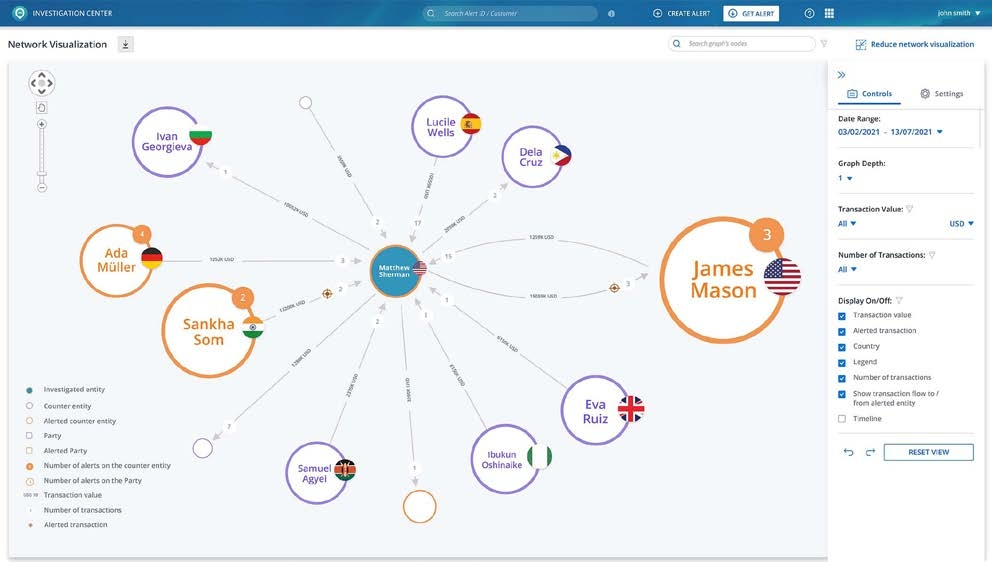
Network visualization, which involves showcasing different data points in a clean and easily digestible manner, is an essential component of an effective machine learning solution. These data points include risk indicators such as high-risk jurisdictions, flagged counterparties, and historical activities of a client, which help analysts form links to find suspicious connections that are potentially indicative of financial crime.
While different financial institutions have different datasets, AI is able to cater to all needs, including working with startups or early stage firms.
Conversely, for large financial institutions that might have different operating models spanning various countries, AI can help segment localized data to draw out trends in specific subsets. There are also a number of jurisdictional challenges and nuances that AI solutions can help address.
For example, institutions operating in emerging markets may be challenged by a lack of digitized databases or unavailable official data records, such as corporate or property records. Remittance firms often have sparse Know Your Customer (KYC) data and infrequent transactions to draw on, making it difficult to determine the baseline of normality for an individual client. Because AI solutions enhance detection by analyzing trends across datasets, they can can provide more accurate results in use cases such as these.
Case study
Travelex Bank is Brazil’s largest foreign exchange provider, offering a range of international money transfer products including import/export, remittances, and mass payments. The bank contends with stringent Brazilian regulation and as it operates in mass payments, generates huge volumes of transactions every day. Travelex Bank implemented ThetaRay Transaction Monitoring anti-money laundering solution for both domestic and international transaction monitoring, as well as real-time sanctions screening for its international payments.
Results of adopting an AI solution:
- In the proof of concept (POC), completed in only 3 days, Travelex Bank was able to process 30,000 transactions per minute.
- Full integration was completed in only 2 months.
- Travelex Bank reported a 10x reduction in false positives.
- Increased efficiencies by deploying an AI solution, allowed for a 30-40% predicted business growth.
Deploying an AI-powered solution is viewed as cost prohibitive, and justifying those costs is front and center of decision-making for businesses. However, AI solutions can help accelerate business growth in a number of ways:
Enhancing Risk Detection
Detect real instances of financial crime as well as previously unidentified typologies, increasing risk coverage. It also enables analysts to focus on value-add activities; identifying opportunities for business growth, highlighting trends, supporting wider stakeholders with reporting and being able to draw more impactful insights from data.
Enabling business scalability keeping compliance cost
Allow firms to process more transactions without proportionally increasing compliance costs, enabling business expansion and increased client acquisition.
Expanding business scope
AI powered transaction monitoring is better at detecting real risk and handling business fluctuations, thus firms can expand their scope of business confidently without necessarily increasing their risk exposure. An institution can thus explore new clients or deals in jurisdictions
previously deemed too risky.
Encouraging financial inclusion
Provides the ability to serve the traditionally underbanked and encourage financial inclusion.
Reducing false positives
Reduce the need for large teams of analysis investigating unproductive alerts.
Eliminating unnecessary investigation work provides long-term benefits including staff retention. With 87% of organizations having no additional capacity due to staffing issues6, it’s crucial that firms focus their teams on value added contributions.
Ensuring regulatory compliance
Global AML penalties are on the rise, with fines surging more than 50% in 2022. A robust AML compliance program helps avoid severe fines.
Evolving FCC detection
No need for constant reconfiguration and able to continuously learn and adapt based on ongoing data collection and analysis.
Case study
NOW Money is a Dubai Fintech, and the Gulf Cooperation Council’s first mobile banking solution focused on financial inclusion. It helps customers excluded from the traditional banking system send remittance payments abroad as quickly and cheaply as possible. NOW Money partnered with ThetaRay to monitor cross-border payments and support the detection of financial crime.
“Anything to do with cross-border requires the best technologies and the ability to use AI. From NOW Money’s perspective, we want to be best-in-breed when it comes to compliance, audit and governance, so we need to work with good parties like ThetaRay”.
Noel Connolly, CEO at NOW Money
Adopting an AI monitoring solution has helped NOW Money process transactions efficiently so that their customers’ families can receive payment without delay. The number of false positives has dropped dramatically, and the centralized investigation dashboard allows for the quick distribution of work so cases are dealt with faster. The solution also instantly screens beneficiaries, which enables teams to deal with flagged individuals and alerts immediately, speeding up the process and retaining customers by preventing unnecessary customer friction.
Most obviously, financial institutions that leverage AI solutions in their FCC programs benefit from enhanced risk detection, which helps them remain regulatorily compliant and avoid hefty fines.
Another important benefit is the simple integration and ongoing use of AI solutions. Traditional rule-based solutions require regular testing and reprogramming of scenarios and thresholds. Upon discovering a new financial crime typology, it can take 6-12 months to reprogram legacy systems to detect it.
By then, criminals have likely devised new methods rendering the solution out of date again. Conversely, AI solutions don’t need constant reconfiguration and are able to continuously learn and adapt based on ongoing data ingestion and analysis.
As criminals innovate and crimes become more complex, financial institutions must adapt. Rule-based systems are resource-intensive, provide only partial coverage, generate increased false positives, and unintentionally introduce bias. Their inefficiencies strain compliance resources and leave firms vulnerable to bad actors and regulatory fines.
By adopting a risk-based approach with AI, firms can enhance transaction monitoring, identify previously undetected risk, increase overall risk coverage, reduce compliance costs and ensure regulatory compliance. AI-powered solutions transform compliance from a cost center to a profit generator, allowing financial institutions to expand into new markets and customer segments previously deemed too risky all the while maintaining compliance.
About ThetaRay
ThetaRay harnesses the power of Cognitive AI for Financial Crime Compliance, enabling financial institutions to precisely identify legitimate customers while flagging bad actors. Our SaaS solutions overcome the limitations of traditional rule-based systems by shortening long implementation lifecycles, enabling efficient, risk-aware compliance operations. By uncovering hidden criminal networks and delivering actionable insights, we empower organizations to combat evolving threats, maintain positive regulator relationships, and enhance customer experiences. ThetaRay helps financial institutions thrive, fostering trust and confidence across the global financial ecosystem.
FINTRAIL is a global financial crime consultancy. We’ve worked with over 100 leading global banks, FinTechs, other regulated financial institutions, RegTechs, venture capital firms and governments to implement industry-leading approaches to combating money laundering and other financial crimes.
With significant hands-on experience, we can help you build, strengthen and assure your transaction monitoring program to meet evolving regulatory requirements, use technology effectively, and stay competitive.
Sources:
- FATF Risk based approach for the Banking Sector
- Global Investigation Review, 2020
- Per ThetaRay research, 2023
- Europol
- Per ThetaRay research, 2023
- Deloitte, 2023
- Financial Times, 2022