

Human Trafficking Risk Detection for the FIFA World Cup 2026
Practical Operational Guideline for Financial Institutions
Executive Summary

Jonathan Halevy
SVP Solutions Experts
The FIFA World Cup 2026 will create a concentrated and time-bound financial crime risk window across the United States, Canada, and Mexico. During the tournament, lawful economic activity will increase sharply across travel, lodging, transportation, hospitality, entertainment, peer-to-peer transfers, cash usage, and temporary labor markets.
This temporary shift in customer behavior creates a major monitoring challenge for financial institutions. Activity that may normally appear unusual can become common during the tournament, while illicit activity may be deliberately hidden inside legitimate event-related commerce.
Human trafficking risk is especially difficult to identify through financial data alone. Individual transactions may look ordinary when reviewed in isolation. A hotel payment, a rideshare charge, a small peer-to-peer transfer, or a cash withdrawal may not be suspicious by itself. The risk emerges when these actions are viewed together across customer behavior, counterparties, locations, timing, business profile, and network relationships.
The purpose of a major-event monitoring framework is not to prove that human trafficking occurred. Financial institutions are not law-enforcement bodies. The purpose is to identify activity that warrants timely review by qualified investigators, compliance teams, financial intelligence units, fraud teams, or law-enforcement liaison teams.
A defensible approach should therefore focus on five operational objectives:
- Identify customers, accounts, businesses, and networks whose behavior changes materially during the event period.
- Prioritize unusual activity when it aligns with known human-trafficking typologies.
- Provide investigators with clear explanations, evidence, and next review steps.
- Avoid overwhelming investigation teams with broad event-related false positives.
- Maintain strong governance, human oversight, auditability, and model-risk discipline.
The recommended approach is anomaly-first monitoring supported by network context, typology alignment, event geography, and investigator-led review.
Compliance frameworks must align with three distinct, event-specific regulatory directives implemented for the tournament:

United States (FinCEN)
FINCEN Notice FIN-2026-NTC1 (Notice on the Threat of Human Trafficking During the 2026 FIFA World Cup) establishes strict tracking mandates. Financial institutions must expedite SAR filings related to tournament trafficking and use the dedicated tracking code: FIN-2026-HTWORLDCUP. The directive explicitly instructs banks to look past traditional dollar limits and report suspicious activity regardless of threshold.

Canada (FINTRAC)
The FINTRAC Special Bulletin FINTRAC-2026-SB003 warns that syndicates intentionally camouflage illicit profits within heightened tournament commerce. The bulletin highlights risks from structured, round-dollar P2P transfers and rapid velocity transport bookings.

Mexico (UIF/CNBV)
The joint Unidad de Inteligencia Financiera and Comisión Nacional Bancaria de Valores (CNBV) alert mandates enhanced Prevención de Lavado de Dinero (PLD) vigilance. FIs must actively track real-time fund routing, front-men accounts, and cash fluctuations across metropolitan and transport hubs.
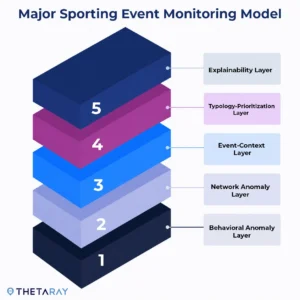
A practical major-event monitoring model can be organized into five layers.
1. Behavioral Anomaly Layer
This layer identifies customers or businesses whose activity materially deviates from their normal behavior or from comparable peers.
Examples include sudden increases in peer-to-peer credits, unusual counterparty counts, abnormal cash withdrawals or deposits, travel and accommodation spikes, unusual debit activity, payroll mismatches, or rapid onward movement of funds after receipt.
The purpose is to separate normal event-related activity from behavior that is unusual for the specific customer, business, or segment.
2. Network Anomaly Layer
Human trafficking can be networked. Individual accounts may not appear highly suspicious in isolation, but linked activity may reveal coordination.
The network layer should examine shared identifiers, connected counterparties, repeated flows, common cash-access points, shared contact details, exposure to previously suspicious entities, and many-to-one or one-to-many fund movement patterns.
This layer is important because organized activity often appears fragmented when reviewed account by account.
3. Event-Context Layer
The event-context layer connects financial behavior to the World Cup operating environment.
This includes host-city proximity, match-day windows, stadium and fan-zone geography, airports, hotels, transport hubs, nightlife districts, temporary labor markets, and event-related commercial activity.
The goal is not to treat proximity to the event as suspicious by itself. The goal is to understand whether otherwise unusual financial behavior becomes more meaningful when it occurs during a relevant event window or near a relevant event location.
4. Typology-Prioritization Layer
Typology indicators should be used to prioritize and explain anomalies, not to generate alerts in isolation.
Examples include peer-to-peer inflow concentration, vague payment memos, rapid onward transfers, multi-city cash movement, lodging and transport patterns, online advertising activity, labor-intensive businesses with weak payroll evidence, and transactions involving linked or previously suspicious entities.
The strength of the alert comes from the combination of unusual behavior, network context, typology alignment, and event relevance.
5. Explainability Layer
Every alert should produce a clear, human-readable explanation.
Investigators should see the top drivers, baseline deviation, peer comparison, typology indicators, event-window relevance, linked entities, supporting transaction examples, and recommended next review actions.
The explanation should be written for operational use. It should allow an investigator, QA reviewer, audit team, or regulator to understand why the case was prioritized and what evidence supported the recommendation.
Scenario 1: Peer-to-Peer Consolidation Near a Host City
A consumer account in or near a host city receives a sharp increase in peer-to-peer credits from many unrelated senders. Several memos contain vague service-related terms. Most funds are moved onward within hours to a small number of external accounts. Activity increases during a match week.
The case is prioritized because the customer’s behavior changed materially from prior history, the number of unrelated senders is unusual, the funds are rapidly consolidated, and the pattern aligns with known financial indicators that may warrant review.
Scenario 2: Labor-Intensive Business With Absent Payroll
A cleaning-services business operating in a host city shows a revenue increase before the tournament. The business makes payments for lodging, transportation, and bulk food purchases, but payroll is absent or materially below comparable businesses. Several individuals receiving wage-like deposits transfer funds to the same owner or controller.
The case is prioritized because the revenue increase is not supported by a normal labor-payment pattern. The concern increases if the business, owner, recruiter, address, or counterparty has links to prior suspicious activity or adverse intelligence.
Scenario 3: Multi-City Cash Movement
A customer deposits cash into ATMs in one city and quickly withdraws cash in another city. During the event period, the account shows activity across multiple host cities, with withdrawals clustered at unusual hours and no prior history of multi-city cash behavior.
The case is prioritized because the activity is unusual for the customer, involves rapid geography changes, and occurs within a relevant event corridor.
Scenario 4: Advertising and Adult-Service Payment Pattern
A customer with no relevant business profile begins making recurring payments to online advertising platforms, adult-service-related websites, hosting services, and telecom providers. At the same time, the account receives multiple peer-to-peer transfers from unrelated counterparties and shows increased hotel and rideshare spend near a host city.
The case is prioritized because several indicators combine into a broader pattern: advertising activity, unrelated inflows, support-service spending, lodging and transport activity, and event proximity.
Data Requirements
The model can be built from standard bank data sources, subject to appropriate permissions, privacy controls, and governance.
Minimum useful data sources include customer profile data, account data, transaction data, cash activity, peer-to-peer transfers, card and merchant activity, fund-transfer details, business profile information, and prior case or alert history.
Additional high-value data may include device or IP geography, adverse media, lawfully available online intelligence, hotel and venue geofencing, transport hub mapping, and information-sharing intelligence where legally permitted.
Deployment Plan
A first version of the monitoring framework can be developed rapidly if core transaction and customer data are already available, data dictionaries are understood, privacy requirements are addressed, and an approved analytics environment is ready.
A practical two-week deployment path includes four stages.
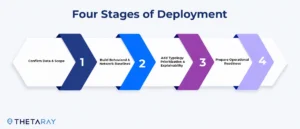
Confirm Data and Scope
The first step is to confirm data availability, define the target populations, validate permissible use, and agree on the event-context map. This includes host cities, match dates, venues, airports, transit hubs, hotel zones, nightlife areas, and relevant business sectors.
Build Behavioral and Network Baselines
The second step is to create customer and peer baselines, engineer behavioral and network indicators, and run the first anomaly-detection outputs. Financial crime subject-matter experts should review early results to identify obvious noise, legitimate event activity, and useful risk patterns.
Add Typology Prioritization and Explainability
The third step is to add human-trafficking typology alignment, incorporate lawful historical case data or investigator intelligence, validate the top alerts, and ensure every output contains clear explanations and evidence examples.
Prepare Operational Readiness
The final step is to prepare investigator templates, review procedures, alert routing, quality-assurance steps, governance documentation, and feedback loops. Production use should begin only after operational owners confirm that the alert volume, explanations, and review workflow are manageable.
Governance and Model Risk Management
Human-in-the-Loop Review
The model should prioritize cases for qualified human review. It should not automatically label a customer as involved in human trafficking. Investigators must remain responsible for final assessment, escalation, and reporting decisions.
No Customer Confrontation
If a financial institution suspects human trafficking, it should follow internal policies and applicable law-enforcement protocols. Customers should not be approached directly about these concerns unless the institution’s policy and legal guidance permit it.
Explainability
Alerts should include the top contributing behaviors, supporting transactions, baseline comparisons, peer comparisons, network context, event-context rationale, and recommended next steps.
Bias and Fairness Controls
The model should not use nationality, ethnicity, immigration status, or other protected characteristics as direct risk drivers. Geography, employment, vulnerability-related indicators, and business-sector indicators should be handled carefully and only in connection with financial behavior and typology relevance.
Threshold Calibration
Thresholds should be calibrated by customer segment, geography, product type, channel, business industry, expected event-related behavior, and available investigation capacity.
Feedback Loop
Investigators should tag reviewed cases as productive, non-productive, requiring more information, escalated, reported, or false positives due to legitimate event-related activity. These outcomes should be used to improve future prioritization and case routing.
Before the Tournament
Financial institutions should define their host-city monitoring scope, identify higher-risk sectors and customer segments, load event calendars and venue geography, build behavioral baselines, prepare investigator guidance, and confirm escalation protocols.
Teams should also agree on the operational limits of automation. The goal is to assist investigators, not remove accountability from the compliance process.
During the Tournament
Institutions should run daily or near-real-time monitoring for priority populations, review high-scoring anomalies first, monitor alert volumes by city and typology, adjust thresholds where legitimate event activity creates noise, and add newly identified typologies or counterparties as lawful seeds where appropriate.
Urgent cases should be escalated according to bank policy and law-enforcement protocols.
After the Tournament
After the event, institutions should review alert productivity, compare model-prioritized cases against investigation outcomes, identify missed patterns, document lessons learned, update governance materials, and retain reusable feature families for future major-event monitoring.
The post-event review is important because major-event typologies can reappear in other sporting, entertainment, tourism, and migration-related contexts.
FAQ
What is the main detection principle?
Do not search only for known red flags. Search for abnormal behavior first, then use human-trafficking typologies and event context to decide which anomalies deserve immediate review.
Should rules be eliminated?
No. Rules remain useful for prioritization, explanation, routing, and quality control. The key distinction is that rules should not be the only detection engine during a major event.
Can this model prove human trafficking occurred?
No. Financial data can identify patterns that warrant review, escalation, or reporting. Human trafficking determinations require appropriate investigation and law-enforcement processes.
What should investigators receive?
Investigators should receive a clear case explanation, supporting transactions, network links, event-context rationale, typology indicators, and recommended next steps.
What makes this approach defensible?
The approach is defensible because it combines behavioral baselines, peer comparison, network context, typology alignment, human review, explainability, auditability, and governance controls.